The clocks go back tonight (25th October).
Officially the clock changes at 2:00 am.
Spring forward
Fall back

Spring forward
Fall back
This is a link to the Community Council Website in its current form.
The URL is https://dunure322579784.wordpress.com/about-dunure/.
This was discussed in the meeting of April this year, at which it was claimed that a website was in final draft form.
I’ve not chosen to put this on the front page of the site. It is my policy to put up only positive items to the public area.
This website is committed to open discussion of issues relevant to Dunure and Fisherton, and will publish items expressing opposing points of view as long as they are supported by logical arguments or published documents.
I repeat my offer to host announcements and minutes of the Community Council, Dynamic Dunure, the Harbour Committee or any other community groups.
Members of the community can then use the site’s tag cloud to access items of interest to them.
A77 Ayrshire Roads Alliance Beacon Broadband Bus Business Pointer Castle Road CC AGM Church Co-opted Members Craig Tara Culzean Way Defibrillator Dunure Castle Dynamic Dunure Festival of the Sea Fishing Gaelic Hall and Park Harbour Harbour Committee Helm Heritage Centre Heritage Lottery Fund Hope Homes Kennedy Drive crossing Kennedy Hall Lighthouse NCCBC Old Well Pedestrian Safety Phone Pub Car Park Road Safety Roadworks Rowing Club Sauchrie Wind Farm Seaview South Ayrshire Council South Road Station Road Traffic Calming Viewing Bridge VOIP Website
If you have items you’d like to see on the site please contact prowrie@dunure.info

The installation should be free, and the connection should be more reliable that the one we have now. The new broadband will probably be cheaper and faster than what we have now.
Many of the suppliers will even pay for the early cancellation costs if your contract still has some months to run.
You can check availability for your house on the OpenReach checker page.
There’s a video on the site which explains the installation in more detail.
If you are considering changing your contract, many of the suppliers will tell you you have to have a new phone number.
You can keep your ‘Dunure’ 500 number – like a mobile phone number that is yours, and
you have a right to keep it! You will find more information at the One Touch Switch site.
It is interesting that the choice was made to seek only positive comments.
Dynamic Dunure claim to reflect the views of Dunure and Fisherton, the ‘will of the people’, yet it seems they are only interested in views which reflect their own. This is not reflecting the views of the village, it is filtering out alternative viewpoints.
Judge for yourself.
Remember, this is a £5 million project, with nearly £1 million in consultation fees alone.
I have asked on numerous occasions for the minutes of Dynamic Dunure meetings, and been met repeatedly with silence.
Likewise, I have asked for results of surveys carried out and the questions asked: again I’ve been answered with silence.
It is difficult to reconcile claims that Dynamic Dunure reflect the views of local people when they routinely refuse to publish minutes of meetings and filter comments from the public to suppress free commentary on their proposals.
It is the view of this site that everyone has a right to their opinion, to express that opinion, and to have their views known without hindrance.
It’s called democracy.

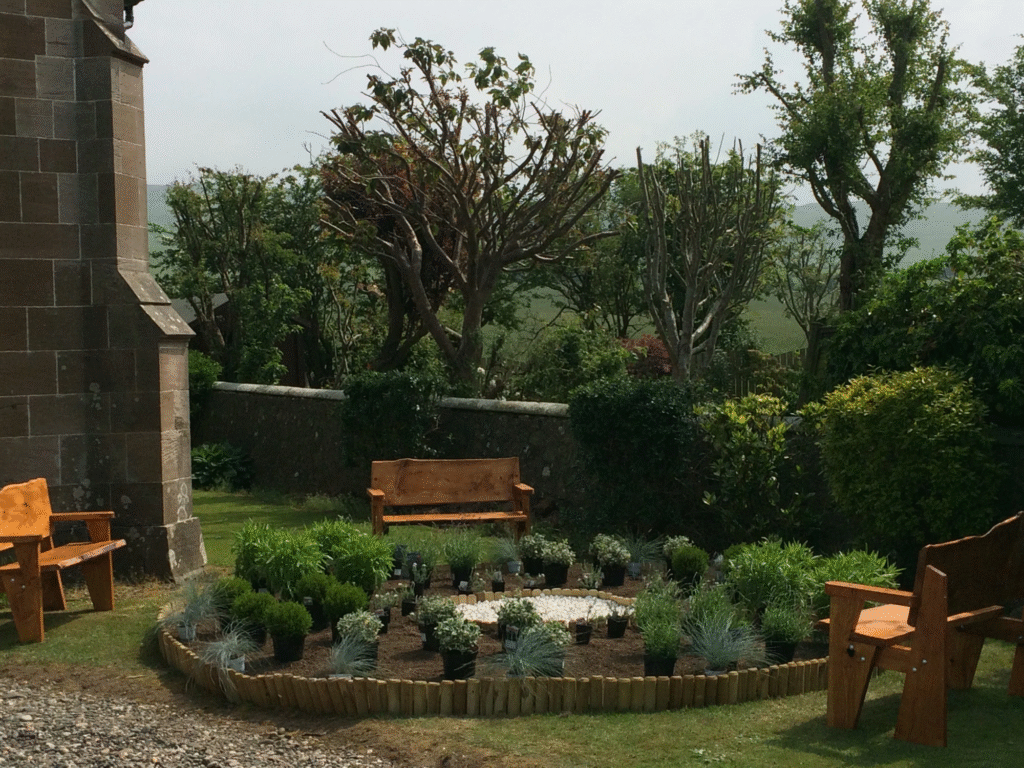

This year’s event has once again received excellent reviews on Facebook.
The organisers have a message:
What a turnout, thanks to everyone who has supported us, we hope you’re having a wonderful time.
MEMBERS OF THE PUBLIC:
Janey McCreath
L. ADOPTION OF PREVIOUS MINUTES (16August 2015):
Proposed: Roy Storie / Seconded: Alex Gibson.
2. POLICE REPORT:
24 lncidents, all specific to the villages of Dunure and
Fisherton, were reported to the Police between the period 16 August 2016 to 20 September 2016.
Comprising:
(a) 11 Calls for lnformation, Advice or Assistance;
(b) 6 Road Traffic Violations (mostly speeding motorrycles);
(c) 3 Notices of Pest-Control Shootings;
(d) 2 Assaults;
(e) 1 Stalking Charge (breach-of-the-peace); and
(f) 1 Housebreaking (theft of tools from a locked garage).
It was noted that this was considerably higher than
previous. The Police Officers fielded some general questions on Crime, on Crime Prevention, and on Police Background Checks, were thanked for their attendance, and left the Meeting at this point.
3. COUNCILLOR’SREPORT:
No Councillor(s) present. There has been no representation from SAC Councillors for the past three meetings. Colette will request the attendance of a Councillor at our next meeting.
4. LINK OFFICER’S REPORT:
Colette advised of the following:
Strengthening our Communities Workshop: Colette can give a Presentation on Community
Engagement if sufficient members of the Community are interested in attending. We will let her know. So far no-one in the Community has expressed any interest.
CommuniN Councils Conference: This will be held in Ayr on 18
November 2O16. Andy has circulated details. Members of the Community Council are encouraged to attend.
Participatory Budqetins Event: Another Funding Event will be
held early 20\7. Colette will advise us of the confirmed date, and of the submission date for applications.
Carrick Communitv Councils Forum: Colette will check on the status of this organisation.
Avrshire Roads Alliance (ARA) lssues: See Summary below:
1. Traffic Speed Survey Results (& Findings) for Station
Road
The Community Council acknowledges receipt of the
Assessment, and notes that the average speed of vehicles crossing the speed-monitoring cable installed at the mid-pointon Station Road (Location 4) was 33.8 mph, which is in-excess of the 30 mph speed limit.
Despite this, the Community Council notes ARA advice that: ‘the current collision record, and the speed survey results, do not support o speed limit reduction, but ARA will continue to monitor this oreo”,
ond “Police Scotland do not support the introduction of o reduced speed limit on Stotion Rood”.
The Community Council requests a copy of the Raw Data
gathered from the Speed Survey at Location 4, and a copy of the referenced advice provided by Police Scotland, and details of how ARA will continue to monitor this area.
7. Our letter on the dangerous nature of Station Road dated
17 September 2015.
The Community Council notes the statement of ARA
Representative: “l hove driven the rood todoy (20 September 2016), ond see no evidence of donger on the corriogewoy”.
It remains the opinion of the Community Council, and local
residents, that Station Road presents many dangers to vehicles, ryclists, pedestrians and school-children, due to:
(a) vehicles exceeding the 30 mph speed limit (now validated
by the Speed Survey);
(b) the transitions from 30 mph to 60 mph, then back to 30
mph;
(c) numerous “blind” corners;
(d) no street lighting;
a very-narrow (typically less than three feet wide) pavement
– on one side only; overgrown hedgerows on the west side; and overgrown trees on the east side.
The Community Council requests a formal response to our
referenced letter.
3. Speed-Activated Warning Signs at the School
The Community Council notes ARA Representative advice that:
“the speed octivoted sign was visited by Engineers in
Moy of this yeor ond reported to be
fully operotionol”, ond “l drove the route todoy,
ond the sign worned me to slow down. I
hod no woy of checking if the pictogram operotes os it was
out-with the times stipuloted”.
The Community Council notes that the subject matter of the
complaint has always been
the (non) operation of the triangular Children Crossing
pictogram element of the Sign, and
not the speed-reduction warning element.
The Community Council notes the content of the “Site
Fault Report Form”, and seeks
clarity on the “Customer” trained to use the
school timer software, and who was informed
about the requirement to test fixed electrical
installations.
Responses to Faults reported via the ARA Website
The Community Council requests clarity on the response which
is provided by ARA, within
the published service commitment of seven working days, to a
Member of the Public who
reports a Fault using the ARA Website.
Potholes on Castle View
The Community Council notes ARA advice that “/ hove
visited the oreo todoy ond would
not consider all of the surface defects to be within o
cotegory 1-,2 or 3. However, I hove
instructed our teom to corry out repoirs tomorrow, including
o significont pothole on
Horbour Rood outside no 5″.
The Community Council notes and appreciates this commitment.
Note: Essential Repairs
were carried-out on 2l September 2076.
Copies of lgcal Road-lnspection Reports
The Community Council understands the following lnspection
Regime is undertaken:
(a) An Annual lnspection of Kennedy Drive, Arran View,
Carrick Place, and Harbour View.
The next lnspection will occur on or around 22March2017;
(b) A 3-Month lnspection of Station Road, Castle View, and
from Castle View to Dunure
Mains. The next lnspection will be on or around 18 November
2016;
(c) A Monthly lnspection of Ayr Road, and from Dunure Mains
to Croy Brae. The next
lnspection will be on or around 03 October 2016.
The Community Council requests copies of all lnspection
Reports.
7. ARA Representative attendance at next CommuniW Council
Meeting
The Community Council notes the requirement to provide
timely requests for ARA
Representative attendance at Community Council Meetings.
The Community Council requests the attendance of ARA
Representative at the next
Community Council Meeting scheduled for 18 October 2016, to
discuss each of the
matters detailed above, and to respond to other issues
concerning local residents.
5. MATTERS ARISING:
(a) Alex to check whether he has completed the Office Bearer
Forms, and the related Data
Protection Forms, and returned them to SAC.
(b) The new Football & Rugby Posts have been installed
in Kennedy Park. An additional Bollard
has also been installed behind one of the Rugby Posts to
prevent Cars from gaining access.
Some redundant materials are still to be removed. Janey
willfollow-up with the lnstaller.
Alex volunteered to attend to this if it is not dealt with
promptly.
(c) Alex has been following-up on the installation of
Superfast Broadband throughout the
Community. lt is now “live” and available to
certain households. Residents are advised to
check availability with their Service Provider (i.e. BT,
SKY, Virgin, Talk-Talk etc.).
(d) The NCCB Small Grant of f3,3OO has been allocated. See
previous Minutes for details of beneficiaries. Steve circulated Evaluation Reports to all beneficiaries. These have been completed and returned to Angus, for issue to NCCB. A ‘Thank-You” card was received from Dunure Youth Club. This was appreciated.
(e) We are grateful to Elaine McQuade for delivering the Box
of Archives relating to Dunure Community Council. Steve has reviewed all content, and uploaded certain items to the
Website (including our Constitution, Minutes of Meetings for
the past 10-Years, and Roy’s Report on the “Geography & Setting of the Villages of Dunure and Fisherton”). The Box will now be relocated and stored safely in Kennedy Hall.
(f) Steve advised that the Dunure Community Council Website
has recently been improved, and encouraged all to visit. www.dunure.net.
6. F!NANCIAL REPORT:
The financial position, for the Working Fund (Bank Account
00584730), is f3,391.40.
Note: Cheques of f50 and f60 were issued to the Dunure Youth
Club and to the Kennedy Hall
& Park Committee respectively, as our annual
contributions. A cheque (of f1,500) will also
soon become payable to the Kennedy Hall & Park Committee
as our contribution to the cost
of new Fire Doors in Kennedy Hall. And so our balance will
be approximately f1″,800.
The Financial Position for the Community Hall Fund (Bank
Account 00584765), is unchanged
from previous, and stands at f3,L45.42.
Roy to arrange for Steve to be an additional signatory on
cheques.
7. CORRESPONDENCE
Not discussed in detail. Relevant emails are distributed by
Andy. Colette will also arrange to
forward any important communications from SAC to Steve.
8. PTANNING APPLICATIONS & DECISIONS
Not discussed in detail. Weekly and Monthly Registers of
Planning Applications & Decisions
are circulated by Andy, and are available for inspection
online at SAC Planning. Link here:
http://pu blicaccess.south-avrshire.gov.uk/on
line-applicatio0s/sea rch.do?action=weeklvList
9. ANY OTHER BUSINESS
Steve obtained a Quote from “Owen Kerr Signs” for
an additional Community Notice Board
to be located near the School, for the benefit of residents
living in the new Hope Homes
(Ladywell) Development. The cost is f 1,230. As our Working
Fund balance s f 1″,800, it was
agreed to defer a decision on this item until we have some
additionalfunds.
A response has been provided to Mrs Dorothy Ward, regarding
the potential conflict of
interest between the local Shop and the Mobile Van which
operates in Kennedy park.
Angus attended an NCCB Directors Meeting on 24 August2Ot6,
and will circulate a copy
of the Minutes, and information on funding streams, to
Steve.
Steve is making good-progress on the application-pack to
LEADER for Funding to restore
the Lighthouse. The deadline for submissions is 20 October
20L6, but we hope to submit
the Application by 30 September 2076. When Steve has
completed the Application, Alex
will liaise with the Harbour Committee on this issue.
5. Two members of the Community (Janey McCreath and Ronnie
Auld) confirmed they will
become Members of the Community Council. This is very much
appreciated. We have
completed the “co-opting” Forms, and Steve will
submit these to SAC. We look forward to
welcoming both of them on-board.
6. Roy advised that he has, over the years, gathered various
articles and materials relating to
the history of the Villages of Dunure and Fisherton. Steve
will arrange to collectthese, scan
and upload them to the Website, and then return them to Roy.
7. Janey advised that Filming of additional scenes for
“Outlander (Series 2)” , in and around
the Castle, is scheduled for 28 September 2016. The Film
Crew will again use Kennedy Hall
for the storage of equipment.
8. Roy commented on the state of vegetation-growth behind
the Bus Shelter. We need a
Volunteer to tidy this up.
9. Roy noted the poor condition of the Post Box. Steve will
send an email to Royal Mail.
10. Angus (via NCCB) obtained a Defibrillator for the
Community. This is located (temporarily)
in Kennedy Hall. A Member of the Public (Mhairi Eaglesham)
has volunteered to be the
point-of-contact should anyone need to use this. Further
detalls on permanent location of
the Defibrillator, and its use, will be issued at a later
date.
10. DATE OF NEXT MEENNG
The Meeting concluded at 9.00pm.
The next Meeting will be held on 18 October 2016. Members of
the Public are welcome. We
hope to have a Representative from Ayrshire Roads Alliance
(ARA) in attendance, to discuss
Roads, Pavements & Street Lighting lssues.
Let’s tease that out.
Firstly, 300 per week is 43 per day. Over an 8 hour day that’s a customer every 11 minutes or so.
That’s one person walking down Kennedy Drive to the ‘Helm’ every 11 minutes, past their neighbour’s house – the neighbour I guess they’re having a cuppa with.
The 300 is expected to be every day of the year, summer and winter. It’s more likely that folks will walk down in summer than winter – twice as likely? So in summer that’s one person every 51/2 minutes walking down Kennedy Drive, past their neighbour’s house.
But it’s more than that – because the ‘Helm’ is likely to be booked at weekends for weddings and events. So we’re more likely looking at 300 visitors per week over 5 days – that’s 60 per day. In summertime we can double the numbers, halve them in wintertime.
I’ve done a wee spreadsheet so you can see for yourself.
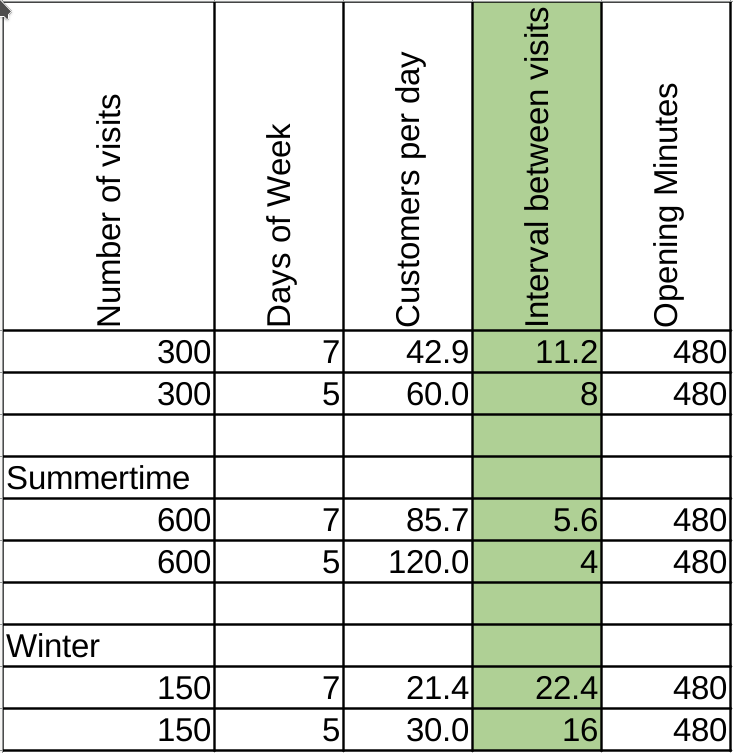
Is that what you expect to see? A constant stream of Dunure residents walking down Kennedy Drive and braving the dangerous crossing into the park?
Well, let’s see what’s on offer for them.
Coffee from a coffee machine. Costing £2.00, so not top quality.
Sorry, this is just not going to fly.
Let me quote from the report:
[If] as the basis for this business plan, we estimate 36,295 visitors to the Helm in year 1, spending (say) £2.00 each, then catering revenue would be £72,590
(Page 5)
If you do the sums, then the ‘business plan’ is expecting is £31,200 per year from residents, £41,392 from visitors.
Was that what you were expecting? If the £31,200 doesn’t materialise, what happens to the jobs the project promises?
Take into account that some of our friends and neighbours are elderly, or disabled, or children, and there’s even less of a chance of the numbers stacking up.