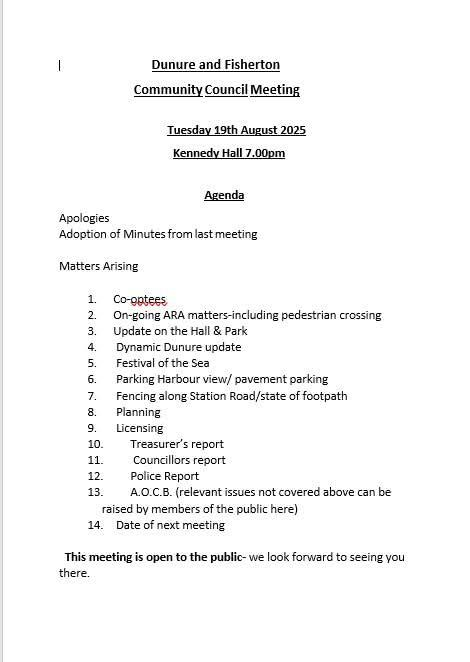
The Communion on Sunday 14th September
will be the final Communion in Fisherton Church.


This year’s event has once again received excellent reviews on Facebook.
The organisers have a message:
What a turnout, thanks to everyone who has supported us, we hope you’re having a wonderful time.
Let’s tease that out.
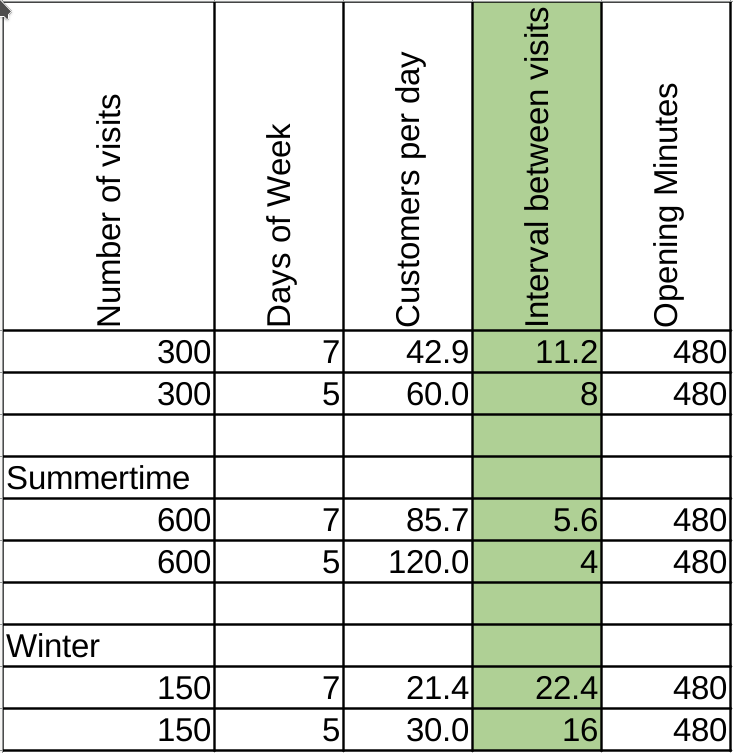
Firstly, 300 per week is 43 per day. Over an 8 hour day that’s a customer every 11 minutes or so.
That’s one person walking down Kennedy Drive to the ‘Helm’ every 11 minutes, past their neighbour’s house – the neighbour I guess they’re having a cuppa with.
The 300 is expected to be every day of the year, summer and winter. It’s more likely that folks will walk down in summer than winter – twice as likely? So in summer that’s one person every 51/2 minutes walking down Kennedy Drive, past their neighbour’s house.
But it’s more than that – because the ‘Helm’ is likely to be booked at weekends for weddings and events. So we’re more likely looking at 300 visitors per week over 5 days – that’s 60 per day. In summertime we can double the numbers, halve them in wintertime.
I’ve done a wee spreadsheet so you can see for yourself.
Is that what you expect to see? A constant stream of Dunure residents walking down Kennedy Drive and braving the dangerous crossing into the park?
Well, let’s see what’s on offer for them.
Coffee from a coffee machine. Costing £2.00, so not top quality.
Sorry, this is just not going to fly.
Let me quote from the report:
[If] as the basis for this business plan, we estimate 36,295 visitors to the Helm in year 1, spending (say) £2.00 each, then catering revenue would be £72,590
(Page 5)
If you do the sums, then the ‘business plan’ is expecting is £31,200 per year from residents, £41,392 from visitors.
Was that what you were expecting? If the £31,200 doesn’t materialise, what happens to the jobs the project promises?
Take into account that some of our friends and neighbours are elderly, or disabled, or children, and there’s even less of a chance of the numbers stacking up.
Costs are given to RIBA 3 for the development phase of the ‘Helm’ project, yet they are only give to RIBA 2 for the delivery phase (page 19).
There’s an important difference between RIBA 2 and RIBA 3.
RIBA is the Royal Institute of British Architects.
RIBA Stage 2 is the concept design phase of planning a building.
RIBA Stage 3 is the ‘Spatial Coordination’ stage, a critical phase where the project’s theoretical aspects transition into concrete realities. Where the plugs go and so forth.
Stage 3 demands a high level of expertise and coordination among architects, engineers, and other specialist consultants, embodying the essence of practical and detailed architectural planning.
Business Pointer haven’t been active as a company since 2013 according to their website, and their telephone number is out of use.
According to Companies House, there is no business entity called Business Pointer registered as a company.
So, more questions arise.
There are serious questions to ask about the details in the plan and the company who prepared it.
The company recommended in the report as an example for the ‘Helm’ to follow is now in liquidation with debts of more than £2 million.
We hope as usual to be down at the harbour with the sun setting in the background.
If the weather is inclement (perish the thought) we will hold our service in Fisherton Church
As always after a short service, we’ll have a wee cup of tea and then a sing song around the campfire.


VOIP is short for ‘Voice Over Internet Protocol’.
That’s all well and good, but there’s one way the old phones were better than the new ones.
The old phones were powered by the phone line, so you could rely on them at all times. The new phones will need a new phone socket, and that socket will need to be powered from the house’s electricity.
So if you rely on having access to a phone line at all times – say for medical reasons or a ‘telecare’ device – you will need to ask for a battery backup pack. If you are vulnerable you should be able to get that free of charge. Don’t worry – nothing happens until 2027 – you have plenty of time to get ready for the change.
If you have a burglar alarm connected to the phone line, you’ll need to check it will work with the new system.
Details are provided by Ofcom – click the button below for more details.
When the changeover happens, your phone company may offer to transfer your existing phone number to the new line. If so, well and good. Not all companies are good at this though, and you may still be locked into months or years of your existing contract.
If your phone company tells you that you’ll have to change to a new number, don’t agree to anything. You can use a process called ‘One Touch Switch’ and keep your own number. Basically, you choose who you want to run your landline, tell them a few details, and choose a date for the switch. You may need to set up a new contract for the landline separately from the broadband.
You should be able to get a new ‘VOIP’ phone included in your new contract. Just make sure your old number gets transferred at the same time.
I’ll put up details on changing phone contracts in a separate post.
The new fibre connections will allow much faster connections to the internet. If you opt to stay with your existing cabling you will probably see only a small increase in speed. That is, you’ll have FTTC (Fibre To The Cabinet). To get the full advantage of the connection you’ll need to upgrade to a fibre connection to your house (FTTP or Fibre To The Property). The upgrade will probably be free, depending on your supplier: they’ll change the copper wire to your house with a fibre cable using the same telephone pole.