Category: Dynamic Dunure

Dynamic Dunure meetings and information

  • What Good Communication Looks Like

    What Good Communication Looks Like

    How Other Scottish Community Trusts
    Talk to Their Villages

    In short:

    Dunure has a community body — Dynamic Dunure SCIO (SC051144) — named in South Ayrshire Council’s National Lottery Heritage Fund application as the intended long-term steward of the project (Appendix 1, “Opportunities” section). The project itself involves just under £900,000 from the National Lottery, alongside a South Ayrshire Council commitment of over £2 million for the Helm building, bridge and associated works — figures reported in Dynamic Dunure’s own newsletter in the North Carrick Community News.

    When an organisation speaks for a village and handles decisions of this scale, the question of how it communicates with that village stops being a matter of style and becomes a matter of accountability. The first post in this series described how difficult it is for a Dunure resident to learn even basic facts about how that partnership operates. This post asks the natural next question: what does good communication actually look like for a body of this kind? Fortunately, we don’t have to guess. Scotland has hundreds of community development trusts and community companies, and the best of them have set a clear, achievable standard. This post looks at three of them.

    The benchmark: what the sector itself says

    The Scottish Governance Code for the Third Sector, developed by Scotland’s Third Sector Governance Forum and endorsed by SCVO, is the sector’s own statement of best practice. Among its five core principles is board behaviour: a well-run board, collectively and individually, should demonstrate mutual respect, integrity, openness and accountability. The Code applies to organisations of every size — how each principle is met scales with the organisation, but the principle itself does not disappear because a charity is small.

    The regulator is moving in the same direction. From 2026, OSCR is publishing charity trustee names on the Scottish Charity Register, and charity accounts submitted from March 2026 will appear on the Register in full — changes OSCR describes as being designed to improve transparency and strengthen public trust in the sector.

    In other words: the statutory minimum is rising, and the sector’s own code has always expected more than the minimum. The organisations below show what “more than the minimum” looks like in practice.

    Example 1: Mull and Iona Community Trust

    Mull and Iona Community Trust (MICT) is one of Scotland’s longest-established community trusts, delivering housing, transport, childcare and environmental projects across the islands.

    What stands out is not the scale of its projects but the openness of its practice:

    • Its stated values are “Open, Democratic, Accountable and Enterprising” — and it acts on them.
    • Board meeting minutes are published in a document library on its website, year by year.
    • Members are welcome to attend board meetings. Membership is open to every resident of Mull and Iona.

    The published minutes are not sanitised summaries. They record who attended, declarations of interest, disagreements, financial figures down to the sale of old laptops, and named action points. A resident of Mull can read exactly what their trust discussed and decided, and who was responsible for what.

    Source: mict.co.uk — About Us and Document Library pages.


    Example 2: Comrie Development Trust

    Comrie is a Perthshire village of around 2,500 people — a community not so different in scale of ambition from Dunure, and its trust took on a far larger asset than anything proposed here: the 90-acre Cultybraggan Camp, bought on behalf of the community in 2007.

    Comrie Development Trust (CDT):

    • Publishes its AGM papers openly. The notice of directors’ elections, accounts, minutes and annual reports all sit on a dedicated AGM page of its website, announced on the homepage.
    • Has a large, visible membership — over 450 members, elected board positions, and sub-committees.
    • Keeps an open door. The Trust runs a main-street office and explicitly welcomes anybody to come in and talk about what it does.

    Membership is free, and the Trust describes its members as “the lifeblood” of the organisation. Recruitment to the board is advertised openly, including public appeals when more volunteers are needed.

    Source: comriedevelopmenttrust.org.uk.

    Example 3: Applecross Community Company

    Applecross Community Company (ACC), a registered charity (SC042865) serving a remote Wester Ross peninsula, is perhaps the most directly relevant example, because it has managed major capital projects — community-led housing, a filling station, broadband — and has itself received National Lottery Heritage Fund support.

    ACC’s practice:

    • Full AGM packs are published online: the meeting booklet with agenda and director nomination form, draft minutes of the previous AGM, and the annual audited accounts — for both the charity and its trading subsidiary.
    • Key project documents are published, not summarised. When ACC explored taking on Camusterrach Church, it put the full feasibility study and the full business plan on its website for anyone to read before members voted.
    • Regular plain-English newsletters go out by email and are archived on the website. They are written in short, direct sections — one project at a time — and have included question-and-answer sections on major projects, inviting readers to ask directors anything not covered.
    • Proxy voting and remote participation are actively facilitated, with named contacts and phone numbers for anyone unsure how to take part.

    The February 2015 newsletter is a good miniature of the approach: it told members how many times the directors had met, what training they had received, when the AGM was, that board spaces were available, and how to stand — all in plain language, with a Q&A on the central capital project appended.

    Source: applecrosscommunitycompany.org


    What these organisations have in common

    Across three very different communities, the same habits recur:

    1. Minutes and agendas are published — routinely, on the website, not on request.
    2. Meetings are open. Members can attend board meetings (MICT) or are actively equipped to participate in general meetings, including remotely (ACC).
    3. Accounts and annual reports go beyond the statutory filing. Full audited accounts are placed on the organisation’s own website, where the community actually looks — not just lodged with the regulator.
    4. Major project documents are published in full. Business plans and feasibility studies are shared before decisions, so members vote on evidence, not assurances.
    5. Membership is promoted, not merely permitted. It is free, open, described as the lifeblood of the organisation, and accompanied by clear, advertised routes to stand for election.
    6. Newsletters are written to be read. Short sections, one topic at a time, plain words, and an invitation to ask questions.

    None of this requires money. It requires a website page and a decision to be open — Dynamic Dunure already has one sitting unused.

    A note on membership conditions

    It is worth being precise about one point. Members of any SCIO have statutory duties under section 51 of the Charities and Trustee Investment (Scotland) Act 2005: OSCR’s guidance confirms that SCIO members must seek, in good faith, to ensure the organisation acts consistently with its charitable purposes. Where a membership form restates those duties, it is stating the law, and no criticism attaches to that.

    But the comparators show there is a real difference between stating the law and building hurdles around it. MICT, Comrie and Applecross all treat membership as something to be maximised: free, open to all residents, actively encouraged. Where a membership application instead requires prospective ordinary members to declare, in advance, their roles in other village organisations — with those declarations “considered in assessing your application” — the practical effect is worth reflecting on in a small village where active residents are, almost by definition, involved in several groups. Conflict-of-interest management is normally a matter for trustees when decisions are taken, handled through declarations at meetings — exactly as the published minutes of MICT demonstrate — not a filter applied at the door to ordinary membership.


    The ask

    Nothing in this post asks Dynamic Dunure to do anything unusual. It asks it to do what comparable Scottish community organisations already do as a matter of course:

    • publish board and general meeting agendas and minutes;
    • publish annual accounts and reports on its own website;
    • publish the key documents behind major decisions before they are made;
    • open its meetings to members;
    • promote membership without pre-vetting applicants’ village affiliations; and
    • write newsletters that a busy resident can actually read.

    A body that describes itself as representing the collective voice of the village has every reason to welcome that standard. The organisations above show it is not a burden. It is how trust is built.


    This is part of a series of blogs asking for honest, open and informed debate on the future of Dunure and Fisherton.


    Dynamic Dunure is cordially invited to respond to anything in this article. Any response received will be published here in full and unedited. Corrections to any factual error, supported by evidence, will be made promptly and acknowledged.


    Sources

  • Does It Really Need to Be This Hard?

    Does It Really Need to Be This Hard?

    In short:


    How hard should it be for a Dunure resident to find out how decisions about Dunure are made?

    This is the story of one attempt — a Freedom of Information request, an internal review, weeks of waiting — and of what was found at the end.

    But first, for contrast, consider Barr — a South Ayrshire village roughly a tenth the size of Dunure and Fisherton. There, if you want to know what the community’s charity discussed last month, you click a link. The minutes are on the village website, filed by date, going back years. The full business plan for their community hub is there too, appendices and all.

    In Dunure, this is what the equivalent journey looks like.

    Dynamic Dunure does not publish agendas or minutes of its meetings.

    There is no accessible list of members. As a charity, it is not subject to freedom of information law — residents have no statutory right to ask it for anything. So the only formal route to understanding how decisions involving our village are being made runs through South Ayrshire Council, which is subject to FOI, and which describes itself as Dynamic Dunure’s partner in the Helm project and the National Lottery Heritage Fund bid.

    Dynamic Dunure has, in the past, had a website on Wix (dynamicdunure.wixsite.com/my-site-1). Captures of the site show ‘placeholder’ content throughout — either explicit ‘(Test Text – TBA)’ markers or Wix’s own unedited default text (“This is a paragraph. Click ‘Edit Text’…”) — on every page.

    The Contact page carried no actual contact information. When it was live the site didn’t give out any information.

    The FOI route was tried.

    A freedom of information request was made to the Council on 27 April for, among other things, minutes of its meetings with Dynamic Dunure — the named community partner in a bid of just under £900,000, attached to a Council commitment of over £2 million. The Council’s first response failed to answer the request, and the matter had to go to internal review (Ref: FOI/2026/16573 — read the full correspondence here). The review, decided on 23 June, upheld the complaint: the Council had failed to provide the information held, confirm what was not held, or give reasons for non-disclosure, as the Freedom of Information (Scotland) Act requires.

    There are no minutes

    And when the definitive answers came, this was among them: there are no minutes. Not withheld minutes. Not redacted minutes. The Council confirmed that no meetings between it and Dynamic Dunure were minuted, and that no such information is recorded on Council records. The same decision states that there is no record of a precise chain of command for the management of the Lottery bid.

    Pause on what that means. A resident who wants to know how a partnership handling millions of pounds of public and Lottery money actually operates must:

    • discover that the community body’s own website carries no substantive information beyond placeholder text
    • discover that, as a charity, it cannot be FOI’d
    • identify the Council as the only accountable partner
    • submit a formal request
    • wait
    • escalate to internal review
    • wait again

    — and finally learn that the statutory process has led to an empty room. Weeks of procedure to establish that the paper trail residents are looking for does not exist.

    Update, 22 July 2026

    The Council’s Information Governance team has since confirmed, in writing, that it does not intend to add anything further to the Internal Review response. Its letter notes the right to appeal to the Scottish Information Commissioner, and invites a new, more narrowly framed FOI request should one be needed. No further information has been offered.

    Compare the effort on each side of that exchange

    Publishing minutes takes a volunteer secretary an hour and a website page. Barr does it on a near-monthly basis. Elsewhere in Scotland — on Mull, for instance — community trusts have published board minutes for years and welcomed members to sit in on meetings. At Dundonald, the charity running the castle visitor centre circulates two regular newsletters by email and publishes a full annual report. And Dunure itself has done this before: the village’s own 2019 Community Action Plan published its survey questions, its participation numbers and its results — unflattering findings included. The posts that follow in this series will look at each of these examples in detail.

    Against that, the current arrangement asks residents to run a statutory obstacle course to learn anything at all — and rewards them, at the end, with confirmation that the Council wrote nothing down.

    Openness is not an administrative burden that small organisations cannot carry. Smaller organisations than Dynamic Dunure carry it every month, in this county, by choice. The burden in Dunure has simply been shifted — off the organisation that holds the information, and onto the residents who are entitled to it.

    This matters

    And there is a reason this matters beyond principle. The same internal review decision confirms, in the Council’s own words, that the Lottery bid was made on the basis of the project being taken forward in collaboration between the Council and Dynamic Dunure — “with Dynamic Dunure holding responsibility for the project legacy”. Legacy stewardship is, at its core, an exercise in precisely the disciplines at issue here: keeping records, reporting to funders, and accounting to a community, year after year. So the question is not rhetorical. If minuting a meeting and publishing a survey are beyond the partnership today, on what basis should Dynamic Dunure be entrusted with a responsibility measured in decades? That is a question councillors — and the National Lottery Heritage Fund — are entitled to ask before further commitments are made.

    It does not need to be this hard

    A single web page — minutes, accounts, membership information, survey results — would end this entire exercise overnight.

    The question the village is entitled to ask is why, after several years and an FOI internal review, that page still doesn’t exist.


    Two further posts will set out the evidence in detail: What Good Communication Looks Like will examine how leading Scottish community trusts communicate with their communities, and Closer to Home shows the same standard already being met in Ayrshire — including, once, in Dunure itself.


    Dynamic Dunure is cordially invited to respond to anything in this article. Any response received will be published here in full and unedited. Corrections to any factual error, supported by evidence, will be made promptly and acknowledged.


    Sources: South Ayrshire Council, Internal Review Decision, Ref FOI/2026/16573, 23 June 2026 (Questions 2–4), published in full at whatdotheyknow.com; South Ayrshire Council, Information Governance (FOI) response, 22 July 2026, published at whatdotheyknow.com; Business Pointer, Dynamic Dunure — The Helm Centre Business Plan, September 2024 (population of Dunure and Fisherton, p.24); barrvillage.co.uk (published minutes and business plan; village population); mict.co.uk (published board minutes; open board meetings); dundonaldcastle.org.uk (newsletters and annual report); nccbc.org.uk, Dunure Community Action Plan 2019–2024; Dynamic Dunure, North Carrick Community News, pp. 34–35 (funding figures); dynamicdunure.wixsite.com/my-site-1 (site screenshots on file).

  • Welcome News for the Harbour —

    Welcome News for the Harbour —

    But Follow the Money

    In short:


    Let’s start with what deserves to be welcomed, because it really does.

    On 29 June, South Ayrshire Council announced that Dunure’s Living Heritage has secured development funding from the National Lottery Heritage Fund. The priorities named in the bid are the right ones: the B-listed harbour, the “at risk” sandstone light-tower, the castle and dovecot, the disappearing oral histories of Dunure’s fishing families, and the replacement of the village’s corroded interpretation boards. These are the assets we have consistently argued need protection, and recognition from the Heritage Fund — backed by the effort of local volunteers — is good news for Dunure. Credit where it is due.

    Now look at where the money actually goes.

    Half a million pounds before a single stone is touched

    The development phase is funded by £180,936 from the Heritage Fund, £300,000 allocated by the Council, and £50,000 which Dynamic Dunure is described as still “in the process of securing” — roughly £531,000 in total. It runs until September 2027.

    And what does £531,000 buy? According to the Council’s own announcement: specialist surveys, conservation planning, access audits, design workshops, feasibility studies, consultation exercises, and pilot activities. What it does not buy is repair. Not one stone of the light-tower repointed, not one block of the breakwater reset, before late 2027 at the very earliest — and only then if the project succeeds in a second application for a delivery budget described as “exceeding £1.1 million”.

    Sit those two figures side by side. Over £530,000 to plan and study; a little over £1.1 million to actually do the work. Roughly a third of the programme’s total cost will have been spent before any conservation work begins.

    To be fair to all involved: a development phase is not a scandal in itself. It is how the Heritage Fund’s two-stage process works for larger grants, and good conservation genuinely requires investigation and design. Nobody sensible wants Victorian masonry repaired without a specification. The question is not whether to plan. It is whether this much planning, at this cost, over this timescale, is proportionate — and the bid documentation itself supplies reasons to ask.

    We have studied this before

    Buried in the Council’s own bid appendix is a remarkable admission. Describing the risks to the Castle and Dovecot, it states that ARPL Architects’ 2022 condition survey “has not been acted upon”.

    Read that again. The Council commissioned a professional condition survey four years ago. It was not acted on. The stonework it described has spent four further winters deteriorating. And the response, in 2026, is to fund a new round of surveys — while the bid elsewhere concedes that at the harbour, “maintenance has been delayed, funding unavailable”, and that the light-tower is severely eroded with “unpredictable structural capability”.

    Every year spent studying an eroding structure is a year in which the eventual repair grows larger and more expensive. The bid itself makes this argument — it describes the light-tower as at risk of collapse. It is difficult to see how the urgency described in the application is answered by a programme in which the earliest possible repair is eighteen months away and the funding for it not yet secured.

    And where is Dynamic Dunure in all this?

    The award was made to South Ayrshire Council. The Council’s Community Asset Team submitted the bid. The consultants will be commissioned and paid through the development budget the Council controls.

    Dynamic Dunure — the community partner — receives none of this. Its role in the funding is to contribute: the £50,000 it is still working to secure, on top of the development costs which, by its own newsletter’s account, were loaned to it by the village’s local groups, some of which put their own activities on hold to do so. Yet the same bid assigns Dynamic Dunure “responsibility for the project legacy” — the long-term stewardship of everything the money creates. And as a recent Freedom of Information review confirmed, the Council holds no record of a precise chain of command for managing the bid, and no minutes of its meetings with Dynamic Dunure.

    So the structure, as documented, is this: the village’s community groups lend money in; consultants are paid out; the Council holds the budget; and the community body ends up holding the long-term responsibility — with no published record of how any of it is decided.

    The harbour does not need the Helm

    One more thing the documents make clear, and it is worth being straight: the case for the harbour stands entirely on its own.

    A resident who supports the harbour works but questions the Helm is not opposing “the project” — they are reading the project’s own documents

    Dynamic Dunure’s own newsletter says so in terms. The physical construction of the Helm, it states, is “a separate project sitting outside of this specific NLHF bid” — of the application of just under £900,000 described there, only £40,000 related to heritage displays within the Helm. The bid appendix tells the same story: the capital works are listed item by item — the light-tower dismantled and rebuilt, the occulting wall consolidated, the quays and breakwater repointed, the footpath spine, the car parking, the village-wide signage — and each stands alone. The Helm appears once in that list, as a “proportion of new build costs” to house exhibition displays. And the money is separate too: the Helm’s construction is funded by the Council’s own £2 million+ commitment, not by the Heritage Fund award.

    Follow the logic of the project’s own paperwork, then. Every conservation element — the harbour, the light-tower, the castle works, the paths, the signage, the oral histories — could proceed in full if the Helm were never built. The reverse is not true: it is the Helm that leans on the heritage project for its displays and its justification, not the heritage project that leans on the Helm. The dependency runs one way.

    That matters for how the village talks about this. A resident who supports the harbour works but questions the Helm is not opposing “the project” — they are reading the project’s own documents, which describe them as two separable things. And it would matter even more if anyone were ever tempted to present the two as a package: to suggest that support for the harbour is conditional on accepting the Helm. Nothing in the funding structure creates that condition. If that linkage were ever made, it would be a political choice — and the documents quoted here would be the measure of it.

    Supporters of the harbour, above all, should be asking: does tying the two together not put the harbour at risk?

    The funder’s own strategy points the same way. The National Lottery Heritage Fund’s Heritage 2033 strategy states a clear preference for conserving and reusing existing heritage over new construction, and the Fund’s guidance requires applicants to explicitly justify why any new build is necessary. Within this bid, the conservation works — the harbour, the light-tower, the castle — need no such justification; they are exactly what the Fund exists to support. The one element that does need justifying is the “proportion of new build costs” for the Helm. In other words, the element of this bid that sits least comfortably with the funder’s own priorities is the Helm contribution — and the elements that sit most comfortably are the ones that stand entirely on their own. One more reason to consider the two cases separately.

    Which raises a question that supporters of the harbour, above all, should be asking: does tying the two together not put the harbour at risk? The delivery funding is not yet won — it depends on a second application, assessed against that Heritage 2033 strategy. Bundling a new-build element that must be specially justified into an application whose conservation case is unanswerable means the strongest parts of the bid carry risk imported from its weakest. If the Fund finds the new-build justification wanting, it is the light-tower that could pay the price. The surest route to funding the repairs to the harbour is a grant application in which the conservation works stand on their own — as the documents show they can.

    What would put this right

    Three things, none of them difficult:

    1. Publish the development-phase budget breakdown. How much of the £531,000 goes to consultancy and professional fees, how much to the Community Heritage & Interpretation Officer post and training pilots, and how much — if anything — to physical works. If the balance is defensible, publishing it costs nothing.
    2. Publish the Partnership Agreement. The bid states that the governance arrangements between the Council and Dynamic Dunure are “encapsulated in the Partnership Agreement” at Appendix B. That document defines who decides what. It should be on the Council’s website.
    3. Commit, publicly, to sequencing the harbour first — and confirm the conservation programme is not contingent on the Helm. If the delivery phase proceeds, the at-risk light-tower and harbour walls — the assets the bid says cannot wait — should be repaired ahead of any spending connected to new building. The heritage case for urgency is the bid’s own; the spending priorities should match it. And since the documents show the conservation works stand independently of the Helm, the Council and Dynamic Dunure should have no difficulty confirming that they will be delivered whatever the Helm’s fate.

    Dunure’s heritage has waited a long time for this level of attention, and the attention is welcome.

    The village is entitled to see that it produces scaffolding and repairs to the light-tower and harbour — not just invoices for reports about it.


    Dynamic Dunure and South Ayrshire Council are cordially invited to respond to anything in this article. Any response received will be published here in full and unedited. Corrections to any factual error, supported by evidence, will be made promptly and acknowledged.


    Sources

    • South Ayrshire Council, “Dunure’s Living Heritage Project Moves to Development Phase”, 29 June 2026 (development-phase funding figures; scope of development activities; delivery budget “exceeding £1.1 million”; Council’s £2 million+ commitment to the Helm Centre)
    • Appendix 1, National Lottery Application Information — released by South Ayrshire Council under FOI/2026/16573 and published on whatdotheyknow.com (ARPL Architects’ 2022 condition survey “has not been acted upon”; light-tower “at risk” on the Buildings at Risk Register with unpredictable structural capability; harbour maintenance delayed with funding unavailable; capital work details; Partnership Agreement at Appendix B; capacity-building of Dynamic Dunure to maintain the project’s legacy)
    • South Ayrshire Council, Internal Review Decision, Ref FOI/2026/16573, 23 June 2026 (bid submitted by the Council’s Community Asset Team, 12 November 2025; Dynamic Dunure holding responsibility for the project legacy; no minuted meetings; no record of a chain of command), published in full at whatdotheyknow.com
    • National Lottery Heritage Fund, Heritage 2033 strategy (Investment Principle 2, p.3 — preference for conservation and reuse over new build); NLHF written parliamentary evidence, January 2025 (Section 3.2, p.13 — requirement to justify new build)
    • Dynamic Dunure, North Carrick Community News, pp. 34–35 (development funding loaned by local groups; Helm construction “a separate project sitting outside of this specific NLHF bid”; £40,000 of the application allocated to heritage implementation within the Helm)
  • Questions for Dynamic Dunure

    Your accounts add up to a surplus of £69,474.00 –

    So why are you borrowing money from other local charities to fund a bid? Why do you need a crowdfunder?

    Where has the money gone?

    How can you justify spending £290,000

    On ‘Community and public engagement activities’ when there has been not a single written item of feedback from your consultations so far?

    South Ayrshire Councillors are on record that they want social enterprises to run like businesses –

    Have you found a single Community Centre that runs on operating income only, as you propose for the Helm?

    A visitor centre very like the proposed Helm was built for £4 million.

    It too was based on optimistic visitor numbers. It has now failed and the land was sold on for £150,000 for housing development.

    That centre was built despite concerns from the community about its business plan and what would happen if it closed.

    Similar concerns are being raised now about the Helm. What is your answer to these concerns?

    How do you communicate with the community?

    You have a website with no meaningful content, you have no facebook page, you don’t publish notice of meetings, you don’t publish minutes, and your newsletters are so poorly written as to be incomprehensible.

    Fisherton Church was highlighted for its potential at your meeting in 2022

    Why did you not consider it further?

    You could have bought it for the price of the ‘Community and public engagement activities’!

  • NCCBC Consultation

    The North Carrick Community Benefit Company are holding a meeting

    The meeting flier was put out on Facebook, and we reproduce it for those who’re not on Facebook or who may have missed it. It doesn’t appear on the NCCBC website.

  • Dynamic Dunure update March 2026

    Dynamic Dunure update March 2026

    We’ve had an update from Dynamic Dunure.

    It appeared on the Dunure Facebook page on Monday (9th March).

    It’s quite hard to read it there, so we’ve printed the text below.

    This isn’t an updated Business Plan, which we were hoping for.

    Our initial analysis of the Business Plan has been revised, and will be shared with the community as soon as possible.

    Given that South Ayrshire Council are on record saying that they cannot afford to subsidise community centres, it is alarmingly likely that after the first year the Helm will either be closed or sold to the private sector.

    The village would then have no community centre at all.

    This is an important development for our village, and it needs frank and open debate both for and against.


    Dynamic Dunure Update


    p.s. The figure given by Dynamic Dunure for the contribution of South Ayrshire Council of £2 million is incorrect.
    The correct figure is in fact nearer to £3 million (Community Council minutes of November 2025).

  • Dynamic Dunure Call for Positive Comments

    Dynamic Dunure have published a newsletter calling for positive comments on their proposal for the ‘Helm’.

    It is interesting that the choice was made to seek only positive comments.

    Dynamic Dunure claim to reflect the views of Dunure and Fisherton, the ‘will of the people’, yet it seems they are only interested in views which reflect their own. This is not reflecting the views of the village, it is filtering out alternative viewpoints.

    Judge for yourself.

    Remember, this is a £5 million project, with nearly £1 million in consultation fees alone.

    I have asked on numerous occasions for the minutes of Dynamic Dunure meetings, and been met repeatedly with silence.

    Likewise, I have asked for results of surveys carried out and the questions asked: again I’ve been answered with silence.

    It is difficult to reconcile claims that Dynamic Dunure reflect the views of local people when they routinely refuse to publish minutes of meetings and filter comments from the public to suppress free commentary on their proposals.

    It is the view of this site that everyone has a right to their opinion, to express that opinion, and to have their views known without hindrance.

    It’s called democracy.

  • Dynamic Dunure Public Meeting 15th November 2022

  • One Unrealistic Assumption of Business Pointer’s report

    Business Pointer get the bad news out of the way first.

    For the ‘Helm’ to make a profit there needs to be at least 300 customers per week from Dunure itself, added to the revenue from visitors to the centre.

    Let’s tease that out.

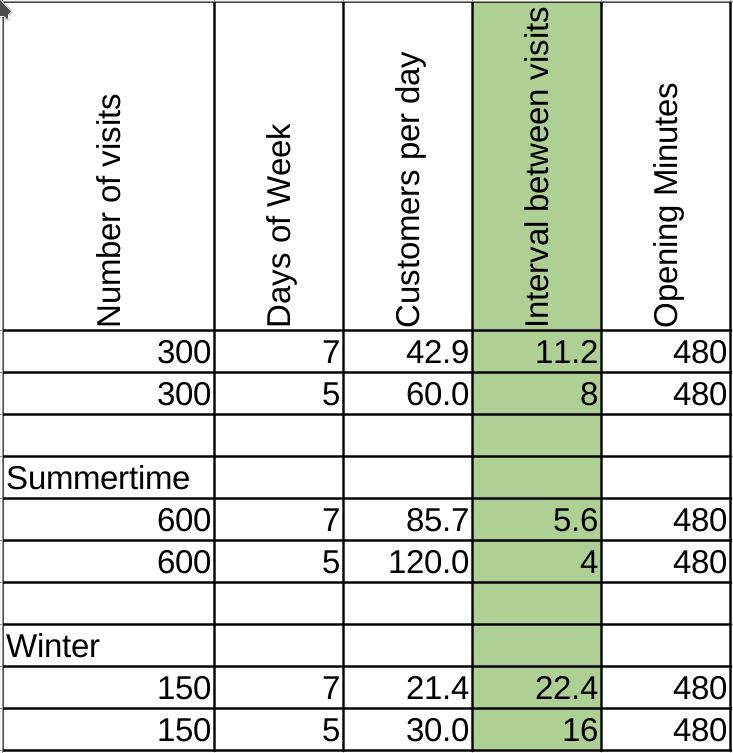
    Firstly, 300 per week is 43 per day. Over an 8 hour day that’s a customer every 11 minutes or so.

    That’s one person walking down Kennedy Drive to the ‘Helm’ every 11 minutes, past their neighbour’s house – the neighbour I guess they’re having a cuppa with.

    The 300 is expected to be every day of the year, summer and winter. It’s more likely that folks will walk down in summer than winter – twice as likely? So in summer that’s one person every 51/2 minutes walking down Kennedy Drive, past their neighbour’s house.

    But it’s more than that – because the ‘Helm’ is likely to be booked at weekends for weddings and events. So we’re more likely looking at 300 visitors per week over 5 days – that’s 60 per day. In summertime we can double the numbers, halve them in wintertime.

    I’ve done a wee spreadsheet so you can see for yourself.

    Is that what you expect to see? A constant stream of Dunure residents walking down Kennedy Drive and braving the dangerous crossing into the park?

    Well, let’s see what’s on offer for them.

    Coffee from a coffee machine. Costing £2.00, so not top quality.

    Sorry, this is just not going to fly.

    Let me quote from the report:

    [If] as the basis for this business plan, we estimate 36,295 visitors to the Helm in year 1, spending (say) £2.00 each, then catering revenue would be £72,590

    (Page 5)

    If you do the sums, then the ‘business plan’ is expecting is £31,200 per year from residents, £41,392 from visitors.

    Was that what you were expecting? If the £31,200 doesn’t materialise, what happens to the jobs the project promises?

    Take into account that some of our friends and neighbours are elderly, or disabled, or children, and there’s even less of a chance of the numbers stacking up.

    Why didn’t Dynamic Dunure pick up on this?
    Why didn’t they ask for a new draft report?

  • Architects set to make more than expected

    There’s a large underestimate of the architects’ fees in the ‘business plan’.

    Costs are given to RIBA 3 for the development phase of the ‘Helm’ project, yet they are only give to RIBA 2 for the delivery phase (page 19).

    There’s an important difference between RIBA 2 and RIBA 3.

    RIBA is the Royal Institute of British Architects.

    RIBA Stage 2 is the concept design phase of planning a building.

    RIBA Stage 3 is the ‘Spatial Coordination’ stage, a critical phase where the project’s theoretical aspects transition into concrete realities. Where the plugs go and so forth.

    Stage 3 demands a high level of expertise and coordination among architects, engineers, and other specialist consultants, embodying the essence of practical and detailed architectural planning.

    In other words, Stage 3 plans can be expected to cost the same as Stage 2 again, possibly much more than that.

    Stage 2 costs £1,670,000 – how much will it cost to go to Stage 3?

    Likewise the costs for the car park and access – Stage 2 costs £490,000 – how much extra for Stage 3?

    Similarly, costs for the landscaping: £350,000 to Stage 2.

    The fees for ‘the above’ are given as £222,009: how much more will they rise to bring the project up to RIBA Stage 3?

    Will it cost the same again – more? – much more? – we just don’t know.

    What we do know is that there is a built-in cost overrun to this project.