But Follow the Money
In short:
- Half a million pounds is being spent on plans and studies before a single stone is repaired
- The Council was already told what to fix in 2022 — and didn’t act on it
- Dynamic Dunure has no say over the money, and no minutes exist of key meetings with the Council
- The harbour repairs don’t need the new Helm building — they can go ahead on their own
- Three simple things the Council could do right now to fix this
Let’s start with what deserves to be welcomed, because it really does.
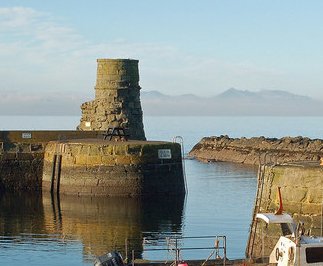
On 29 June, South Ayrshire Council announced that Dunure’s Living Heritage has secured development funding from the National Lottery Heritage Fund. The priorities named in the bid are the right ones: the B-listed harbour, the “at risk” sandstone light-tower, the castle and dovecot, the disappearing oral histories of Dunure’s fishing families, and the replacement of the village’s corroded interpretation boards. These are the assets we have consistently argued need protection, and recognition from the Heritage Fund — backed by the effort of local volunteers — is good news for Dunure. Credit where it is due.
Now look at where the money actually goes.
Half a million pounds before a single stone is touched
The development phase is funded by £180,936 from the Heritage Fund, £300,000 allocated by the Council, and £50,000 which Dynamic Dunure is described as still “in the process of securing” — roughly £531,000 in total. It runs until September 2027.
And what does £531,000 buy? According to the Council’s own announcement: specialist surveys, conservation planning, access audits, design workshops, feasibility studies, consultation exercises, and pilot activities. What it does not buy is repair. Not one stone of the light-tower repointed, not one block of the breakwater reset, before late 2027 at the very earliest — and only then if the project succeeds in a second application for a delivery budget described as “exceeding £1.1 million”.
Sit those two figures side by side. Over £530,000 to plan and study; a little over £1.1 million to actually do the work. Roughly a third of the programme’s total cost will have been spent before any conservation work begins.
To be fair to all involved: a development phase is not a scandal in itself. It is how the Heritage Fund’s two-stage process works for larger grants, and good conservation genuinely requires investigation and design. Nobody sensible wants Victorian masonry repaired without a specification. The question is not whether to plan. It is whether this much planning, at this cost, over this timescale, is proportionate — and the bid documentation itself supplies reasons to ask.
We have studied this before
Buried in the Council’s own bid appendix is a remarkable admission. Describing the risks to the Castle and Dovecot, it states that ARPL Architects’ 2022 condition survey “has not been acted upon”.
Read that again. The Council commissioned a professional condition survey four years ago. It was not acted on. The stonework it described has spent four further winters deteriorating. And the response, in 2026, is to fund a new round of surveys — while the bid elsewhere concedes that at the harbour, “maintenance has been delayed, funding unavailable”, and that the light-tower is severely eroded with “unpredictable structural capability”.
Every year spent studying an eroding structure is a year in which the eventual repair grows larger and more expensive. The bid itself makes this argument — it describes the light-tower as at risk of collapse. It is difficult to see how the urgency described in the application is answered by a programme in which the earliest possible repair is eighteen months away and the funding for it not yet secured.
And where is Dynamic Dunure in all this?
The award was made to South Ayrshire Council. The Council’s Community Asset Team submitted the bid. The consultants will be commissioned and paid through the development budget the Council controls.
Dynamic Dunure — the community partner — receives none of this. Its role in the funding is to contribute: the £50,000 it is still working to secure, on top of the development costs which, by its own newsletter’s account, were loaned to it by the village’s local groups, some of which put their own activities on hold to do so. Yet the same bid assigns Dynamic Dunure “responsibility for the project legacy” — the long-term stewardship of everything the money creates. And as a recent Freedom of Information review confirmed, the Council holds no record of a precise chain of command for managing the bid, and no minutes of its meetings with Dynamic Dunure.
So the structure, as documented, is this: the village’s community groups lend money in; consultants are paid out; the Council holds the budget; and the community body ends up holding the long-term responsibility — with no published record of how any of it is decided.
The harbour does not need the Helm
One more thing the documents make clear, and it is worth being straight: the case for the harbour stands entirely on its own.
A resident who supports the harbour works but questions the Helm is not opposing “the project” — they are reading the project’s own documents
Dynamic Dunure’s own newsletter says so in terms. The physical construction of the Helm, it states, is “a separate project sitting outside of this specific NLHF bid” — of the application of just under £900,000 described there, only £40,000 related to heritage displays within the Helm. The bid appendix tells the same story: the capital works are listed item by item — the light-tower dismantled and rebuilt, the occulting wall consolidated, the quays and breakwater repointed, the footpath spine, the car parking, the village-wide signage — and each stands alone. The Helm appears once in that list, as a “proportion of new build costs” to house exhibition displays. And the money is separate too: the Helm’s construction is funded by the Council’s own £2 million+ commitment, not by the Heritage Fund award.
Follow the logic of the project’s own paperwork, then. Every conservation element — the harbour, the light-tower, the castle works, the paths, the signage, the oral histories — could proceed in full if the Helm were never built. The reverse is not true: it is the Helm that leans on the heritage project for its displays and its justification, not the heritage project that leans on the Helm. The dependency runs one way.
That matters for how the village talks about this. A resident who supports the harbour works but questions the Helm is not opposing “the project” — they are reading the project’s own documents, which describe them as two separable things. And it would matter even more if anyone were ever tempted to present the two as a package: to suggest that support for the harbour is conditional on accepting the Helm. Nothing in the funding structure creates that condition. If that linkage were ever made, it would be a political choice — and the documents quoted here would be the measure of it.
Supporters of the harbour, above all, should be asking: does tying the two together not put the harbour at risk?
The funder’s own strategy points the same way. The National Lottery Heritage Fund’s Heritage 2033 strategy states a clear preference for conserving and reusing existing heritage over new construction, and the Fund’s guidance requires applicants to explicitly justify why any new build is necessary. Within this bid, the conservation works — the harbour, the light-tower, the castle — need no such justification; they are exactly what the Fund exists to support. The one element that does need justifying is the “proportion of new build costs” for the Helm. In other words, the element of this bid that sits least comfortably with the funder’s own priorities is the Helm contribution — and the elements that sit most comfortably are the ones that stand entirely on their own. One more reason to consider the two cases separately.
Which raises a question that supporters of the harbour, above all, should be asking: does tying the two together not put the harbour at risk? The delivery funding is not yet won — it depends on a second application, assessed against that Heritage 2033 strategy. Bundling a new-build element that must be specially justified into an application whose conservation case is unanswerable means the strongest parts of the bid carry risk imported from its weakest. If the Fund finds the new-build justification wanting, it is the light-tower that could pay the price. The surest route to funding the repairs to the harbour is a grant application in which the conservation works stand on their own — as the documents show they can.
What would put this right
Three things, none of them difficult:
- Publish the development-phase budget breakdown. How much of the £531,000 goes to consultancy and professional fees, how much to the Community Heritage & Interpretation Officer post and training pilots, and how much — if anything — to physical works. If the balance is defensible, publishing it costs nothing.
- Publish the Partnership Agreement. The bid states that the governance arrangements between the Council and Dynamic Dunure are “encapsulated in the Partnership Agreement” at Appendix B. That document defines who decides what. It should be on the Council’s website.
- Commit, publicly, to sequencing the harbour first — and confirm the conservation programme is not contingent on the Helm. If the delivery phase proceeds, the at-risk light-tower and harbour walls — the assets the bid says cannot wait — should be repaired ahead of any spending connected to new building. The heritage case for urgency is the bid’s own; the spending priorities should match it. And since the documents show the conservation works stand independently of the Helm, the Council and Dynamic Dunure should have no difficulty confirming that they will be delivered whatever the Helm’s fate.
Dunure’s heritage has waited a long time for this level of attention, and the attention is welcome.
The village is entitled to see that it produces scaffolding and repairs to the light-tower and harbour — not just invoices for reports about it.
Dynamic Dunure and South Ayrshire Council are cordially invited to respond to anything in this article. Any response received will be published here in full and unedited. Corrections to any factual error, supported by evidence, will be made promptly and acknowledged.
Sources
- South Ayrshire Council, “Dunure’s Living Heritage Project Moves to Development Phase”, 29 June 2026 (development-phase funding figures; scope of development activities; delivery budget “exceeding £1.1 million”; Council’s £2 million+ commitment to the Helm Centre)
- Appendix 1, National Lottery Application Information — released by South Ayrshire Council under FOI/2026/16573 and published on whatdotheyknow.com (ARPL Architects’ 2022 condition survey “has not been acted upon”; light-tower “at risk” on the Buildings at Risk Register with unpredictable structural capability; harbour maintenance delayed with funding unavailable; capital work details; Partnership Agreement at Appendix B; capacity-building of Dynamic Dunure to maintain the project’s legacy)
- South Ayrshire Council, Internal Review Decision, Ref FOI/2026/16573, 23 June 2026 (bid submitted by the Council’s Community Asset Team, 12 November 2025; Dynamic Dunure holding responsibility for the project legacy; no minuted meetings; no record of a chain of command), published in full at whatdotheyknow.com
- National Lottery Heritage Fund, Heritage 2033 strategy (Investment Principle 2, p.3 — preference for conservation and reuse over new build); NLHF written parliamentary evidence, January 2025 (Section 3.2, p.13 — requirement to justify new build)
- Dynamic Dunure, North Carrick Community News, pp. 34–35 (development funding loaned by local groups; Helm construction “a separate project sitting outside of this specific NLHF bid”; £40,000 of the application allocated to heritage implementation within the Helm)