
In short:
- Dynamic Dunure publishes no minutes, no agendas, and no membership list — and unlike a council, it can’t be FOI’d
- Getting basic information out of the Council required a formal FOI request, then a full internal review, after the first response failed to answer it
- The end result: there are no minutes of any meeting between the Council and Dynamic Dunure — none were minuted by SAC
- The Council has confirmed it has nothing further to add to its Internal Review response
- Neighbouring villages and charities do this openly as a matter of routine — it takes a volunteer an hour a month
- Dynamic Dunure is being handed a legacy responsibility measured in decades for a multi-million pound project
- The fix is trivial: one web page of minutes, accounts and membership details would end this overnight
How hard should it be for a Dunure resident to find out how decisions about Dunure are made?
This is the story of one attempt — a Freedom of Information request, an internal review, weeks of waiting — and of what was found at the end.
But first, for contrast, consider Barr — a South Ayrshire village roughly a tenth the size of Dunure and Fisherton. There, if you want to know what the community’s charity discussed last month, you click a link. The minutes are on the village website, filed by date, going back years. The full business plan for their community hub is there too, appendices and all.
In Dunure, this is what the equivalent journey looks like.
Dynamic Dunure does not publish agendas or minutes of its meetings.
There is no accessible list of members. As a charity, it is not subject to freedom of information law — residents have no statutory right to ask it for anything. So the only formal route to understanding how decisions involving our village are being made runs through South Ayrshire Council, which is subject to FOI, and which describes itself as Dynamic Dunure’s partner in the Helm project and the National Lottery Heritage Fund bid.
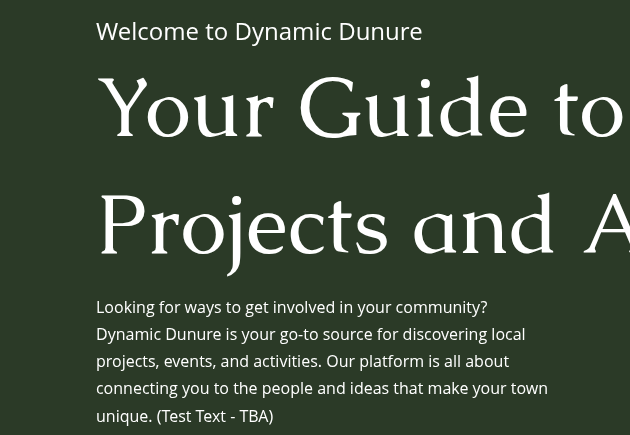
Dynamic Dunure has, in the past, had a website on Wix (dynamicdunure.wixsite.com/my-site-1). Captures of the site show ‘placeholder’ content throughout — either explicit ‘(Test Text – TBA)’ markers or Wix’s own unedited default text (“This is a paragraph. Click ‘Edit Text’…”) — on every page.
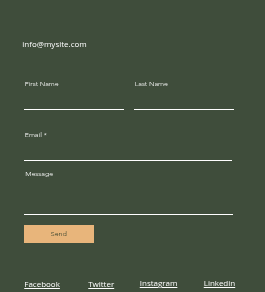
The Contact page carried no actual contact information. When it was live the site didn’t give out any information.
The FOI route was tried.
A freedom of information request was made to the Council on 27 April for, among other things, minutes of its meetings with Dynamic Dunure — the named community partner in a bid of just under £900,000, attached to a Council commitment of over £2 million. The Council’s first response failed to answer the request, and the matter had to go to internal review (Ref: FOI/2026/16573 — read the full correspondence here). The review, decided on 23 June, upheld the complaint: the Council had failed to provide the information held, confirm what was not held, or give reasons for non-disclosure, as the Freedom of Information (Scotland) Act requires.
There are no minutes
And when the definitive answers came, this was among them: there are no minutes. Not withheld minutes. Not redacted minutes. The Council confirmed that no meetings between it and Dynamic Dunure were minuted, and that no such information is recorded on Council records. The same decision states that there is no record of a precise chain of command for the management of the Lottery bid.
Pause on what that means. A resident who wants to know how a partnership handling millions of pounds of public and Lottery money actually operates must:
- discover that the community body’s own website carries no substantive information beyond placeholder text
- discover that, as a charity, it cannot be FOI’d
- identify the Council as the only accountable partner
- submit a formal request
- wait
- escalate to internal review
- wait again
— and finally learn that the statutory process has led to an empty room. Weeks of procedure to establish that the paper trail residents are looking for does not exist.
Update, 22 July 2026
The Council’s Information Governance team has since confirmed, in writing, that it does not intend to add anything further to the Internal Review response. Its letter notes the right to appeal to the Scottish Information Commissioner, and invites a new, more narrowly framed FOI request should one be needed. No further information has been offered.
Compare the effort on each side of that exchange
Publishing minutes takes a volunteer secretary an hour and a website page. Barr does it on a near-monthly basis. Elsewhere in Scotland — on Mull, for instance — community trusts have published board minutes for years and welcomed members to sit in on meetings. At Dundonald, the charity running the castle visitor centre circulates two regular newsletters by email and publishes a full annual report. And Dunure itself has done this before: the village’s own 2019 Community Action Plan published its survey questions, its participation numbers and its results — unflattering findings included. The posts that follow in this series will look at each of these examples in detail.
Against that, the current arrangement asks residents to run a statutory obstacle course to learn anything at all — and rewards them, at the end, with confirmation that the Council wrote nothing down.
Openness is not an administrative burden that small organisations cannot carry. Smaller organisations than Dynamic Dunure carry it every month, in this county, by choice. The burden in Dunure has simply been shifted — off the organisation that holds the information, and onto the residents who are entitled to it.
This matters
And there is a reason this matters beyond principle. The same internal review decision confirms, in the Council’s own words, that the Lottery bid was made on the basis of the project being taken forward in collaboration between the Council and Dynamic Dunure — “with Dynamic Dunure holding responsibility for the project legacy”. Legacy stewardship is, at its core, an exercise in precisely the disciplines at issue here: keeping records, reporting to funders, and accounting to a community, year after year. So the question is not rhetorical. If minuting a meeting and publishing a survey are beyond the partnership today, on what basis should Dynamic Dunure be entrusted with a responsibility measured in decades? That is a question councillors — and the National Lottery Heritage Fund — are entitled to ask before further commitments are made.
It does not need to be this hard
A single web page — minutes, accounts, membership information, survey results — would end this entire exercise overnight.
The question the village is entitled to ask is why, after several years and an FOI internal review, that page still doesn’t exist.
Two further posts will set out the evidence in detail: What Good Communication Looks Like will examine how leading Scottish community trusts communicate with their communities, and Closer to Home shows the same standard already being met in Ayrshire — including, once, in Dunure itself.
Dynamic Dunure is cordially invited to respond to anything in this article. Any response received will be published here in full and unedited. Corrections to any factual error, supported by evidence, will be made promptly and acknowledged.
Sources: South Ayrshire Council, Internal Review Decision, Ref FOI/2026/16573, 23 June 2026 (Questions 2–4), published in full at whatdotheyknow.com; South Ayrshire Council, Information Governance (FOI) response, 22 July 2026, published at whatdotheyknow.com; Business Pointer, Dynamic Dunure — The Helm Centre Business Plan, September 2024 (population of Dunure and Fisherton, p.24); barrvillage.co.uk (published minutes and business plan; village population); mict.co.uk (published board minutes; open board meetings); dundonaldcastle.org.uk (newsletters and annual report); nccbc.org.uk, Dunure Community Action Plan 2019–2024; Dynamic Dunure, North Carrick Community News, pp. 34–35 (funding figures); dynamicdunure.wixsite.com/my-site-1 (site screenshots on file).